How Artificial Intelligence Helps Medical Staff Understand Patient History Faster
In a clinic or hospital, every minute matters. Before an appointment, a doctor may need to review previous diagnoses, treatments, clinical notes, and visits. When a patient’s medical history contains a large amount of information, identifying the most relevant details can take time.
Artificial intelligence offers new ways to simplify this process. Rather than replacing healthcare professionals, AI can help staff organize and summarize information already recorded in the system.
Proklinika integrates this technology to help authorized staff generate a clearer overview of a patient’s visit history.
The challenge of reviewing extensive patient histories
Over time, a patient’s medical record may contain a wide range of information, including:
Previous visits
Diagnoses and symptoms
Recommended treatments
Medications
Test results and documents
Clinical notes
Changes in the patient’s health
Although all this information may be important, not every detail is equally relevant to the current visit. Reviewing a long medical history can become especially challenging for institutions managing many patients and appointments each day.
What is an AI-generated patient history summary?
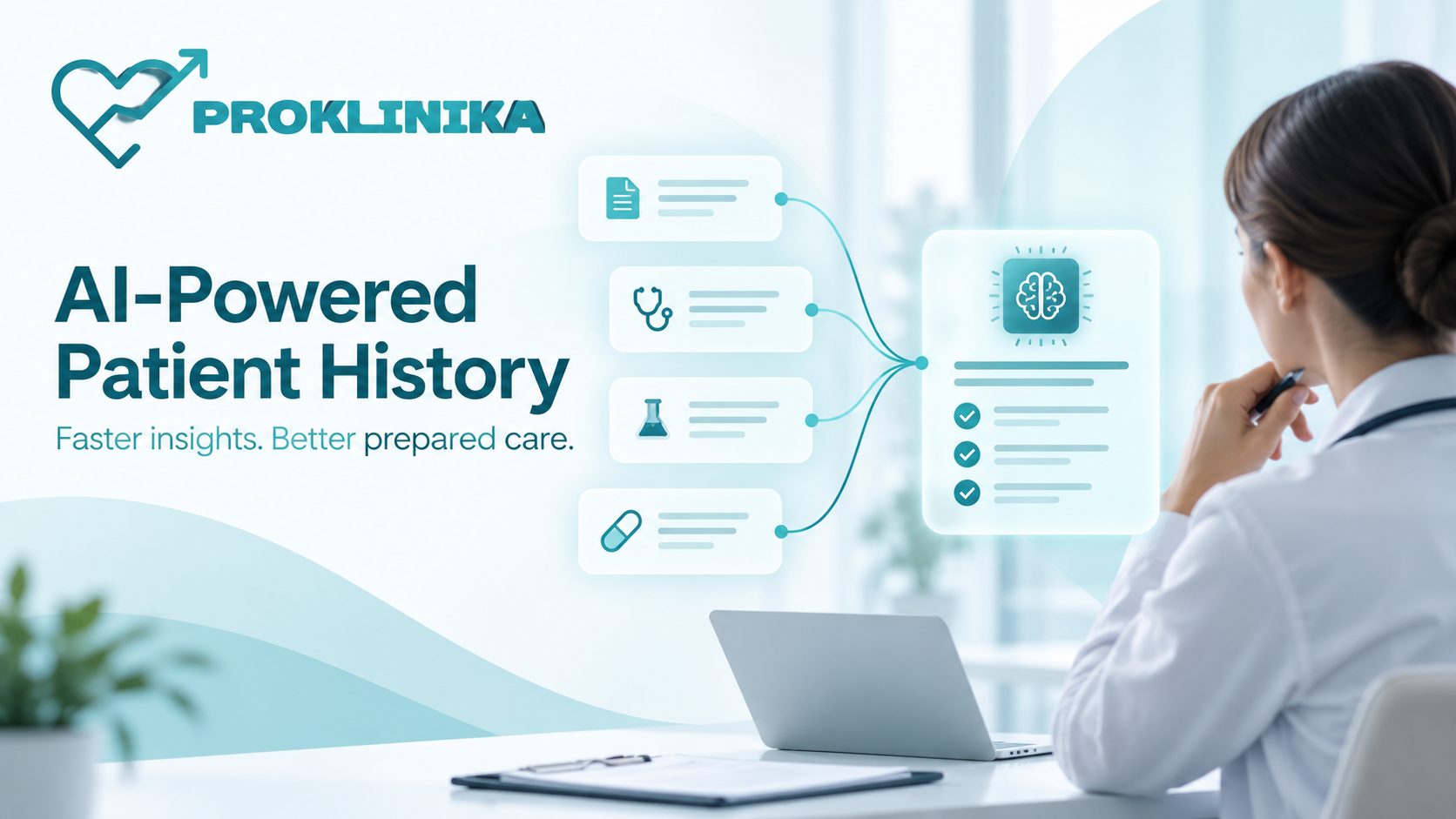
An AI-generated summary analyzes information recorded during previous visits and presents the key details in a shorter, more organized format.
Instead of opening and reviewing every visit separately, authorized staff can receive an overview highlighting the most relevant information documented in the system.
This can help medical staff:
Understand the patient’s history faster
Identify information relevant to the current visit
Prepare more efficiently before a consultation
Spend less time reviewing individual records
Obtain a clearer overview of previous visits
The summary is generated from existing data and should not be considered an independent diagnosis or medical recommendation.
How does this feature work in Proklinika?
Proklinika centralizes patients, medical visits, and documentation in one platform. When an authorized user opens a patient’s record, they can review the complete visit history and use artificial intelligence to generate a summary.
The process is straightforward:
Staff record visits and clinical information in the patient’s electronic record.
The patient’s history is securely organized within the system.
An authorized user requests an AI-generated summary.
Proklinika presents an organized overview of the recorded information.
The healthcare professional reviews the summary and consults the original records whenever necessary.
Artificial intelligence therefore acts as a support tool for organizing information, while professional control and responsibility remain with the healthcare staff.
Less time searching, more focus on the patient
A considerable part of healthcare administration involves searching for, reading, and organizing information.
When this process becomes more efficient, professionals can spend less time navigating through individual records and more time communicating with and caring for patients.
AI-assisted summaries can contribute to:
Faster preparation for appointments
More efficient clinical workflows
Better-organized patient information
Improved continuity between visits
Easier collaboration among staff members
These benefits can be particularly valuable for clinics, polyclinics, and hospitals managing large numbers of patients.
Artificial intelligence does not replace healthcare professionals
Technology can process and organize information, but it cannot replace the experience, judgment, and responsibility of qualified healthcare professionals.
AI-generated summaries should always be reviewed by authorized staff. When making important clinical decisions, professionals should refer to the patient’s original medical records.
The role of AI in Proklinika is to assist healthcare staff—not to make decisions on their behalf.
The importance of accurate data
The quality of an AI-generated summary depends on the quality of the information recorded in the system. If the original data is incomplete or inaccurate, the summary may not provide a complete representation of the patient’s history.
Healthcare institutions should therefore establish clear processes for:
Recording visits accurately
Keeping patient records up to date
Documenting diagnoses and treatments
Reviewing information before saving it
Limiting access to authorized users
Artificial intelligence provides the greatest value when it works with accurate, structured, and up-to-date information.
The future of healthcare management is intelligent
The digital transformation of clinics goes beyond replacing paper records. The next step is using existing healthcare information more intelligently.
By combining electronic patient records, visit histories, and artificial intelligence, Proklinika helps healthcare institutions transform complex information into a clearer and more useful overview for their staff.
Conclusion
Artificial intelligence can simplify how medical staff review patient histories. With organized summaries, healthcare professionals can identify key information faster and prepare more effectively for appointments.
Proklinika brings this capability together with patient, doctor, appointment, and medical visit management in one centralized platform.
Would you like to try Proklinika at your healthcare institution? Start your free 14-day trial or contact us to request a demonstration.